Showing posts with label fears. Show all posts

Thursday, November 03, 2016

Never Let You See Me Cry

I just woke up from a dream with real tears spilling from my eyes. I can't remember the last time that happened.

I dreamed I was out of town with friends, and we'd split up - half to eat and half to shop. I was the last to finish eating and suddenly realized everyone was gone. I started texting everyone, and one by one they told me they'd gone home. I realized I was alone, out of town, with no way of getting home, and everyone had left me.

In the dream, I was panicked, lonely, and afraid. I couldn't find anyone to help me get home. Then after what felt like an hour, I ran into all of my friends. They were laughing. It was all a prank. No one had left, but they thought it would be funny to trick me. I started crying, and they continued to laugh. "Stop being so dramatic!" they told me.

The last words of my dream before I woke up were mine: "Do you guys actually think I would let you see how vulnerable I am, if I weren't seriously upset? Do you think I'd let you see how abandoned and lonely I felt? Do you think I'd actually let you see me cry?"

I woke up, and fat tears were dripping down my cheeks.


I'm reading a book, Emotional Intellligence 2.0. It starts with giving you a code for an online quiz to assess your emotional intelligence. I'd say I'm very emotionally intelligent, so I was actually really annoyed when it scored me much lower than I expected. I read the reasons, and it came down to this: I am a great listener, a great communicator, I'm empathetic and socially aware, BUT. I don't talk about myself enough. I don't open up about my own feelings or weaknesses with others.

At first I thought, "Well, of course not! Communicating is about listening to others and understanding them, not talking about myself." But the more I read, the more I understood what it was saying. Communication is a two-way street. How can others trust me (particularly professionally) if they don't know me? If I don't open up to them while they open up to me, that's not effectual communication. That's not emotional intelligence, to hide your vulnerabilities and weaknesses and fears from the world. That's being a counselor, not a friend.

The part that confounded me at first was the online analysis that I don't share myself. I have this blog, right? I wrote a book about the most vulnerable time in my life, right? But truth is, that's my personal life, and it's also through a medium of written word. In my face-to-face interactions, I don't talk about myself. When someone asks me how I'm doing, I say great and immediately turn it back to them. Today, I spoke on the phone with a friend/work connection who asked how my new job is going. Though surely she wanted details, my response was, "I love it! So how are you?"

I can share myself through ink and paper, keyboards and screens, but not in real life. And this is doubly so when it comes to my professional life.

What I think was most telling about my dream was that the group of friends I was with were my work friends from my most recent job. The last words, "Do you think I'd actually let you see me cry?", speak volumes. I remember once, early on in that job, I was getting extremely overwhelmed, and one of my coworkers (someone I consider a friend) saw me and stopped to talk. The tears welled up in my eyes, my throat got tight, and I couldn't speak without the fear of losing it. I hated, HATED, him see me nearly break down and cry. I was humiliated, and even now my face burns at the memory. It was him that I said this to my dream.

I don't like showing weakness. I don't like asking for help. I want to help others, but I don't want them to help me. I listen to people all day long; I seem to have some kind of magnet for people to share stuff with me. And I love being there for them, listening to them, being a safe place for them to let it all out. But I don't share myself back, not intimately, not in real life beyond the computer screen. I don't want people at work knowing when I struggle or when I'm uncertain. I want to look amazing and self-assured at all times. I feel this is entirely justifiable! Of course I want my colleagues and those who report to me to see me as strong and competent. But do I do myself and everyone else around me a disservice by not being honest about what makes me vulnerable - what makes me just like everyone else?

This is something I am working on. I can be professional at work and still share myself to whatever the appropriate level is. (This is something I still can't figure out; maybe the book will help.) I need to be able to say on some days work is hard. Today was hard. Today I handled a three-child home fire fatality story. It was emotionally a very difficult day. I found myself at times wondering what I'm supposed to do here. I found myself at times wondering if I could really do this job. I had to push my personal emotions aside to get a job done, which I felt guilty about in return. I need to be able to admit this. I know I'm not the only person in the world to doubt herself or feel emotionally conflicted.

I definitely need to work on this with my friends. If I'm asked about myself, I need to talk a little about myself. Most people who genuinely care about me genuinely want to hear how I'm doing. It doesn't make me arrogant or narcissistic. It just makes me real. Human. Emotionally intelligent.

But vulnerability hurts, and I've learned to be ashamed of it.

Sunday, July 24, 2016

Hate and Fear and Death and Anger

With all the hate and fear and death and anger in the world right now, I am finding it hard to breathe lightly. Deep in my gut I feel sickened and exhausted and helpless. The American political climate is volatile, at its eruption point. Fear is being shoveled down our throats, and animosity is poisoning our veins. People are being shot by police, and police are being shot in return. Racism is killing black people, and white people are fighting over who's fault that is. Transgender people are being harassed over bathrooms. Whole religions are taking the blame for the acts of a belligerent few. Personal freedoms of who to love or who to worship are being yanked from some to assuage others. From Baltimore to San Bernardino to Baton Rouge to Falcon Heights to Nice to Munich to Orlando to Dallas, people are being murdered on the regular, sometimes en masse and each time unprovoked.

I believe in optimism. I believe in goodness, and I believe in love. But the hurricane of hate and fear and death and anger twisting all around me is suffocating.  How can I possibly see an American future where racism is obliterated from the bottom to the top, and from the top to the bottom, when half the country still refuses to see it exists? How can I believe that love will conquer hate when hate has become so palatable and carefree that it is openly preached from podiums and pulpits? How can I teach my children to be the change they want to see in the world when the world doesn't want to be changed or even see a need for it?

I recognize that I am a middle-class, married-to-a-man white woman. I cannot pretend to understand the daily concerns and experiences of black people, Muslims, gay and transgender people, undocumented immigrants, asylum seekers or police officers. As an atheist and a woman, I can relate to certain levels of the discrimination but nothing comparable to those who are being threatened with banishment and deportation, who wake up wondering if they will be attacked in a bathroom today, who say "I love you" every time they leave the house in case it is the last time. I cannot relate to that enough to insist "I know what it's like". I don't.

I may not personally experience the hate and fear and anger and death meted upon so many of my fellow mothers and fathers and brothers and sisters, but I see it. Not all of it, but I catch glimpses and glimmers. And they knock the breath out of me. Too often I am a silent observer. I am an observer who does not want to be silent but does not have the words or the platform to say anything or make a difference. I open my mouth to speak, but my own personal fear, my own survival instincts, catch the words in my throat and choke them out. My guilt and ignorance hold my frustration with the world's injustice against me, accusing me of being a part of the problem, and I am rendered silent again. Then I'm reminded that silence is a privilege, and I am hurled back into frustration.

I believe there is good in the world, and I believe in being the change I want to see in the world, but truth be told, both of these beliefs are ephemeral. They are American apple pies in the sky. They are nebulous puffy clouds that shade me from the glaring reality that I do not actually know if there really is good in the world, and I do not believe I can change anything.

This weekend I finished reading two books I've been working on for months. Bad Feminist by Roxane Gay is a wonderful book, mixing humor and critical thought into multiple essays surrounding topics of oppression and inequality for women, for people of color, for people who are not thin, for anyone who does not fit the perfect standards American society holds us to. While I was able to laugh during some chapters, I had to pause and remember to breathe during others. I had to look square in the eye many truths about my perceptions as a white woman that I had not realized needed challenging. I was reminded that the inequality I face as a woman can be frustrating but not as frustrating as the challenges for women who heap inequality upon inequality. Inequality is not binary. The more disadvantages bestowed upon a person for his or her gender or gender identity, sexual orientation, race, religion, hometown, education level - the list goes on - the more discrimination a person is bound to suffer. Sexism isn't experienced by me the same way it is experienced by a black woman or a lesbian woman or a black lesbian woman. The book opened my eyes to the sexism experienced by all types of women, not just women who look like me. I too am a bad feminist.

I also finished Between the World and Me by Ta-Nehisi Coates. I started this book back in February but only finished it today, because it was the hardest book I have ever read. Reading it was like loading concrete blocks onto my chest, one page after another. It is one thing to "know" that black parents have to teach their black sons and daughters how to behave extra good during certain encounters; it is an entirely different thing to read the intensely honest and intimate letter written by a father to his son about the struggle to preserve the black body from destruction. No other book I've read that openly or begrudgingly let me observe a black experience, not Disgruntled or God Help the Child or Why Are All the Black Kids Sitting Together in the Cafeteria, though each of those affected me in profound ways, changed me the way this one did. The hate and anger and death and fear twisting all around us are real dangers to our brothers and sisters of color. Yet we continue to tell them they are either imagining things or they need to sort themselves out by themselves, as if we as a country and a history and a society never did a thing to cause this peril to their bodies.

I am crushed under the inevitability of all the hate and anger and death and fear in our world. It feels like change is not going to come. I do not know what to do about it or how to help. I cannot change the minds of those around me who refuse to see the problems. I am such a small, insignificant fish in a fathomless ocean.

I want to believe in optimism, goodness and love. I want to believe that I can be the change. I want to believe in the story of the starfish, that it matters to walk along the shore and throw starfish back into the ocean, one at a time. I need to believe that the small tangible things I do might matter in the long run - the donations to charities, the volunteer hours, the lessons taught to my children. So small though. Too small.

I also want to know more. I want to be educated in areas I know little or nothing about. I want to read books that tell me truths it hurts to hear.  I want to be challenged and humbled and pushed into action. I want to understand. I don't want to be silent, but I do want to listen. I want to implore others to listen. I want all of us to close our mouths, open our eyes and lean in close to hear what our Muslim neighbors, our gay and transgender neighbors, our black, Hispanic and Native American neighbors, our uniformed neighbors have to say about their experiences and believe them. No "but what about"s or "but I"s or "but you"s.

I want all this hate and death and anger and fear to stop. I know I cannot stop it. I know I cannot escape it. I cannot simply turn off the radio, shut down Facebook, walk away from conversations, and slip under my covers just to make myself more comfortable again. If my fellow mothers and fathers and brothers and sisters do not get the luxury of switching off the TV to find comfort, I will not exercise my ability to do so. I will never fully understand what it feels like to be the target of all this hate and fear and death and anger, but I will continue to face these every day with them. I will continue to immerse myself as much as I can into their worlds through books and relationships and news stories and causes. I will listen when I ought to listen and try to speak when I ought to speak. I will push myself to continue believing in goodness and love, for my children and for my world, however small my influence on it may be. I cannot, I must not let the hate and fear and death and anger win.


Sunday, November 22, 2015

Coming Clean: An Unconventional Book Review of a Christian Book By a Non-Christian Reader

Dear Readers,

This is a little early. Normally I save my book reviews for the Reading Challenge monthly round-up, but I feel this particular book deserves its own post. Excerpted from the draft of the upcoming November book reviews, I bring you less of a book review and more of a personal response to Coming Clean.


Coming Clean by Seth Haines (A book that scares you)

Okay. So I'm really having to stretch here. Really. I've struggled with which book to read for this category all year. I don't want to read anything scary. Why would I do that to myself? I haven't enjoyed scaring myself since I was a teenager. I tried to pick up some truly scary books and had to put them down. I'm all for expanding my horizons, but I'm simply not the least bit interested in reading something scary.

So I'm doing a little creative interpretation.

This book wasn't one that scared me, but the thought of reading it did fill me with something close to dread. Maybe it was a little scary in that I wasn't sure I wanted to read it. Yet, I did want to read it, knowing what I know of the background.

I went to college with Seth's wife Amber (also an author). We were in multiple creative writing classes together. I've studied for tests and eaten meals in her house. I've met Seth, even though it was a long time ago. During the time I was in Scotland, I kept up with Amber's blog, so I remember a lot of this happening (from Amber's point of view). Their infant son was failing to thrive, and I wept with them from a million miles away, I prayed for her baby boy who was slipping away. When I heard that Seth had written this memoir - a diary of his first ninety days of sobriety from alcohol - I wanted to read it. I wanted to know his side.

But I also dreaded reading it, and I couldn't figure out why.

I knew I wasn't looking forward to the God slant of it all. Christianese still rubs me the wrong way. But why would that fill me with dread? Was I worried that this book might wrinkle the bedclothes of my finally comfortable atheism? Was I worried that after all this time, God would speak to me? (Too little, too late?) Was I afraid the fear of hell might rise up within me again, threatening me with its red flames and pitchforks, the laughter of Satan as his claws close around my wrists, and the crossed arms of God looking down, head shaking but not moving to rescue me?

As I started reading the book, several realizations took place. The first explanation for my dread came up almost immediately.  It was "too soon". I'm not as far removed from Christianity as I sometimes think I am. Sometimes, it's just too much, too soon, like a horrible break up. You think you're over it until you re-read your old love letters. I'm not far enough away from it yet to give it the disconnected but respectful deference I can give to other religions. If it were a book by a Muslim or a Jew or even a Mormon, I'd be okay. But this was too close to an almost-healed wound that appears scarred over on the surface but is still tender when pressed.

Very early in, I pinpointed another source of my dread. The fear of jealousy. The prickling feeling of "this guy experienced the silence of God, yet by the end of this book, I'm willing to bet God makes himself known to him." Would this book be a re-visitation of the old Why him and not me? Might there be a jealousy lingering deep down that this guy's faith did not get shaken beyond its breaking point? (To it, yes. But not beyond.)

Despite all these reservations I read the entire book and shared a few tears with him as one who's felt similar darkness. I know the silence of God. I know the doubt, the disillusionment, the pain, the need to numb. I've met the same cast of characters - played by different actors but reading from the same script - the "faith-healers" who make promises they can't keep, the churchgoers who place the fault on your faith (or lack thereof), the trite and glib assertions of "sovereignty" and "God's glory" and "never give you more than you can bear". I know the same theologies that grind against simple faith like tectonic plates and the systematic studies that box up life's complexities (sufferings, dichotomies, mysteries) with pretty Scriptural exegesis ribbons.

We are not that different, this Christian writer and this atheist writer. Not that different at all.

I'll admit here that nestled up with the potential jealousy and the dread and the still-tender wounds was a second-guessing, a head cocked to the other side, a furrowed brow. What I really didn't expect to get from this book was a genuine reconsideration of my own experience. Had I given up too soon? Did I commit the ultimate fail - the Give-Up that scores an F and detention in hell, instead of the Keep Going Despite Everything Rational that warrants an A and heavenly applause?

I wondered that with utmost sincerity - and again, dread. I've been through this before. I've gone there. I've questioned all these things to death and back. Is there something to this, after all this time?

I kept reading. I kept wondering. I questioned my (un)faith along with him questioning his (unsure)faith. The story went on, through the first month, second month, third month of his abstinence from alcohol and his doubt and his desperation to hear God and the silence and the anger and the needing to forgive and the "cave" as he called it where all the darkness hides, and I just couldn't help but think:  Why?

If there is a God and he is this God of the Bible, why on earth does he constantly make faith in him so bloody difficult? When Sunday School tells you to "just believe" and you will be saved, and Gospel preachers say, "you only need faith to be saved" and even the theologians insist "it is by grace and nothing of yourselves", then why would God make faith so impossible to achieve? If it's this gift that only God can give, why does he give it so freely to children and then withhold it so tightly from adults?

Why would he make this simple believing such an impossible mountain to climb, one we have to write books about to even remotely comprehend?

What good does it do to make climbing the mountain of faith so utterly difficult that so many of us eventually lose our grip and crash to the rocks below? What is the truth then, that it is by faith we are saved but by surmounting the insurmountable (the silence of God, the problem of pain, the inconsistencies of Scripture) that we finish the race, make the grade? Does that mean we must do more than just believe to be saved, that there is something we must do of ourselves - a desperate striving, perhaps, while a silent God stands back and observes, clipboard and checklist in hand?

I applaud Seth's journey, and I applaud his resolution. I truly mean that. I loved this book; I loved his writing style, his beautiful imagery, his perfect rendering of the ache of the faith crisis. If I'd read this book two or three years ago, would it have changed the direction of my journey? Maybe, maybe not. My dilemma came from the inconsistencies of Scripture, his from the problem of pain. Our dilemmas might not have crossed paths closely enough for his to affect mine. His denoument, though, is beautiful and enlightening, and I am so happy for him that his faith did not ultimately waiver, and that it is getting him through his struggle with alcohol.

I fear that might come across as patronizing, coming from one who decided that faith is an illusion and God a figment of our imagination. How do I explain that my joy for him is not patronizing at all but genuine?

For I believe he is on the right path. I also believe I am on the right path. I believe all of us who are doing our utmost to find truth and goodness and light and love in this brokenest of worlds are on the right path. I'd have dismissed that kind of talk once as highly new-agey and relativistic; I'd have called myself "deceived" with a sunken heart and a sorrowful sigh. I feel almost Buddhist saying it now. Om. 

I truly mean it though. I never rooted for atheism while reading this story. I hoped the truth would set him free. And unexpectedly with each turn of the page, as he baked bread to satisfy the hunger of his readers' doubts, tiny crumbs of respectful deference dropped onto my plate of cynicism towards Christianity. While the loaf in the end was not for me, the crumbs have given me a warm reminder of what it tasted like to live off that bread.

I remember that a person who lives off that bread is not delusional, any more than a person who does not live off it is deceived.

We are all on the same path.  We are all approaching truth, just from different angles. Call it Eastern and new-agey, call it whatever you want, but this is the truth that I found - most surprisingly - in this book.

It is a little scary. Going from an all-or-nothing faith (or unfaith) to something left of center is new to me. It's easy to say "you're wrong and I'm right"; to say "we all have fingers touching on the truth here" is harder and often more easily dismissed by everyone from all sides.

I made a good choice on a book that scared me. It did wrinkle the bedclothes of comfortable atheism, it did briefly rekindle the fear of hellfire, it did spark a moment or two of jealousy, it did reopen the wounds of once perceived silence and abandonment. In the end, however, after tearing through so many layers of doubt and pain and forgiveness and disappointment alongside the author, I kept returning to the conclusion that if God were real - and loving - he wouldn't make it next to impossible to believe in him. He wouldn't make it so difficult that only a select few - the strongest of the strong, the most emotionally intelligent - make it to the end. For people like Seth have emotional intelligence overflowing in buckets, but it's not only people like Seth whose sons fail to thrive or who suffer the silence of God or who question the childhood experiences of faith. Not everyone has the depth of introspection required to dig far enough into their own caves of darkness to find that one tiny seed of doubt and to root it out like a deeply embedded wart. "Childlike faith" shouldn't take a PhD to achieve. Faith shouldn't require books upon books to explain.

However. Just because it is not the path I am on does not mean it is the wrong path. There are many trails to the top of the mountain. To everyone trying to get there, I recommend exploring all of them. Including Seth's.


Love,
an atheist author and reader


P.S. Yes, I capitalize the G in God, just as I do the A in Allah or the Z in Zeus. This is grammatically correct, religiously respectful, and also incurably habitual.


Tuesday, November 17, 2015

Syrian Refugees Not Welcome in Arkansas

Today I feel sad. Today I feel helpless. Today I feel confused.

A little story. (Not the sad part.)

A colleague of mine who didn't realize that I'd actually lived in Scotland myself (and hadn't simply married a Scottish guy) was surprised when I said I'd move back to Scotland in a heartbeat if the economy here in America wasn't so amazing. She was genuinely shocked.

I said, "I know some people find that hard to believe." 

She responded, "I do. I do find that hard to believe."

I may be generalizing, but in my experience, it seems people who have never lived outside the US have no concept of how great we have it here. Yes, there are some major problems, but generally speaking, America is incredible. We have wealth, we have land, we have a stable government.  I also recognize there a myriad ways our nation could be improved. But regardless, at the risk of sounding 'Murican, we have a great nation.

People here complain about the economy, immigration, taxation, welfare, and just about everything. I don't blame anyone for that either. There are problems with all of these things that need to be fixed. However it seems that those who have never lived anywhere else have very little frame of reference to see how good we have it here.


Now, onto the sad part.

Gov. Asa Hutchinson spoke out today refusing to relocate any Syrian refugees in Arkansas. Aside from the point that legally he can't make that call, it just makes me sad. We have the space and the resources. Arkansas has a population to land ratio of 56 people per square mile.  Compare that to Scotland, where the population density is 167.5 people per square mile (and that's with 130 islands uninhabited). Compare that to the Netherlands where the population density (as of 2007) is a whopping 1258.5 people per square mile. We have the space.

The United Kingdom, which is about the size of Oregon, has said they can handle about 20,000 more Syrian refugees over the next five years. (And many British people believe that is nowhere near enough.)  Meanwhile Germany has said they will be able to accommodate 500,000 Syrian refugees every year for the next several years.  Germany's population density is roughly 609 people per square mile without the projected half a million refugees expected each year for the next several years.

The United States government has decided to relocate 10,000 Syrian refugees. Is that too many? Let's look at it this way. The US has 322,177,652 people (as of 8:16 pm Nov. 17, 2015, according to the United States Census Bureau population clock) living on 3,539,225 square miles of land. Currently that's 91 people per square mile. Should we add another 10,000 people, our population density will rise to... 91.

It's mathematically negligible. 

So we have plenty of space. Space clearly isn't the problem.

Security must be the problem. The US is worried about security and rightly so. Of course, obviously, our government wants to keep the country and its people safe. So to do just that it has created (and is constantly refining) a very robust vetting process for refugees - Syrian ones especially.

According to this article from CNN,
Several federal agencies, including the State Department, the Department of Homeland Security, the Defense Department, the National Counterterrorism Center and the Federal Bureau of Investigation, are involved in the process, which Deputy State Department Spokesman Mark Toner recently called, "the most stringent security process for anyone entering the United States."

These agencies use biographical and biometric information about applicants to conduct a background check and make sure applicants really are who they say they are.

The applicant is interviewed by a DHS officer with training in this screening process as well as specialized training for Syrian and Iraqi refugee cases.

And refugees from Syria actually go through another layer of screening, called the Syria Enhanced Review process.

"With the Syrian program, we've benefited from our years of experience in vetting Iraqi refugee applicants," a senior administration official recently told reporters. "And so the partnerships we have today and the security checks we have today really are more robust because of the experience that we've had since the beginning of large-scale Iraqi processing in 2007." (emphasis mine)
So Syrian refugees are among the most and best vetted of all foreign nationals entering the United States.

While I'd like to say, "we can never be too careful", something about that sticks in my throat. Is it possible actually to become so "careful" that we lose sight of the reality baring its cold, starving nakedness right before our eyes? Can we use national "security" in the same way we use a "security blanket" - a place we can hide our faces from the things that scare us or make us uncomfortable?

It also concerns me that we have targeted one particular race of people to exclude from our compassion and humanitarian care.  Is it right to refuse an entire demographic from relocation in our state or country based almost solely on their country (and religion) of origin? Are we equally scared of refugees from other war-torn nations? Are we pinpointing a people group because of their religion? (If these people were coming from predominantly Christian nations like Kenya or Croatia, would we feel as terrified of letting them in as we are of people from a Muslim one? It's an honest question.)

Furthermore, can we actually become so careful and so fearful that we lose our compassion and empathy for the human race? Can we seriously see images of dead toddlers and not want to do something significant about it? Can we see millions of people fleeing their homes to escape rape, murder, kidnappings, and starvation, risking everything just for the hope of reaching safety and not feel the desire to offer substantial help?

Can't we see that we are a country with significant wealth and land to share with those who have nothing - quite literally, nothing? Alongside our "most stringent security process", surely we can afford to show genuine humanitarian concern for those who are in most unfathomable need. Surely as one of the richest nations in the world we can feed the hungry, clothe the naked, shelter the poor. Surely.


Today I feel sad. Today I feel helpless. Today I feel confused by all the voices rallying against helping their fellow man (and woman and child). Today I feel small and powerless when looking up at the giants of governors and governments who make all the rules. I don't understand why we are so afraid. Today I feel I have nothing to say that hasn't already been said by countless others greater and more powerful than I.

But silence is acceptance. So instead of silence, I lift my small, insignificant voice as high over the crowds as I can to remind us all that we are a great nation with resources to spare. Please, can we do something that will cost us so little yet will affect the world so much? Please, can we confront our fears and bravely open our arms to welcome the children, the families, and yes, even the single men, into the safety of our abundance?

"To whom much was given, of him much will be required."

Sunday, August 09, 2015

The Difference Between a Screen Door and a Porch

A beautiful and wise friend left a comment on my "Screen Doors" post recently. I started to reply in the comments section, but her words said so much, I decided to post them here before replying.

When you were a Christian, didn't you sometimes feel that you had to hold back about expressing your beliefs, for fear of putting a huge block in your relationship with your atheist friends? We all make mistakes and (I think) just stumble along in life. I can be quite critical of others until I realize how many time I put my own foot into my own mouth. So I am not trying to defend anything here, and I figure for every person with fairly clear thinking and fairly good motives, there may be a completely muddled and selfish person, Christian or atheist alike. But I'm trying to say that I think maybe a screen door is an attempt to avoid building a brick wall. I say this because my youngest son hit a faith crisis right about the same time you declared your atheism. I don't think he'd say he's an atheist. I think he believes there is a God; he just doesn't particularly like God right now. Between the two of you, my world has been rocked with a massive sense of loss. Yet I have hope in my Lord, and I pray for Him to reveal His light and beauty and grace. When I held my tiny baby boy and felt all that mother-love for him, when I nursed him and burped him, washed him and dressed him, cared for him and delighted in how cute he was and the funny things he said and did, I never imagined that we would be here at this point today. I still love him with all my heart, but there are many things I cannot say to him. To me, this is my screen door: I am open to him, I long to have a full relationship with him. I pray for him multiple times every day. He is always welcome in my home. I love to be able to cook for him, or do his laundry, although he rarely allows me to. When he wants to talk, I am ready, I respond. But I have to wait. I have to wait for him to open the door. My screen door is unlocked and I stand behind it watching the horizon for his silhouette, hoping like crazy that he will come home and turn the handle.

First, let me say what a beautiful picture she just painted. It brings tears to my eyes. I remember lying on my side in the still and silent hours of the night, cradling my nursing infant son in the crook of my arm and crying noiseless tears over the enormity of my responsibility to him.  As I struggled with my own faith during those days and months, I prayed with all the strength of my being that he would grow to love God and that he would be saved. Nothing frightened me more than the idea of my perfect baby boy (or either of my perfect girls) rejecting Jesus as their Savior and spending eternity in hell. I remember the passion, the pain and the desperation I felt as I begged the Lord to spare my children, to spare this innocent child at my breast, to give them all life everlasting, in spite of my own shortcomings.

I remember like it was yesterday.

And I can only imagine it gets harder with age, as these young people develop into their own selves, and create their own identities and pursue their own paths. For a believing mother to watch her child struggle with faith or turn from it completely must be heart-wrenching agony to say the least.

But to respond further to what my friend said, let me say that I don't think she has put up a screen door at all.  Judging by her words, it sounds more like she and her son are both sitting on the porch swing, sipping a glass of iced tea together and trying to understand.  They've met in the middle.


I feel like this with my own mom. I know it kills her that I'm not a believer anymore. I know her heart aches, and I know the number of tears she has shed is uncountable. But she's not hiding inside behind a screen door, keeping me out, waving to me from a distance. She has stepped outside, feeling a little out of her comfort zone, to meet me on the porch. And I too have had to step out of my comfort zone to join her there. It's not comfortable for me to face the pain my unbelief causes her, but I do not want to walk away or avoid her. I would rather walk up those steps and join her on the porch, both of us feeling a little unsure of what to say but allowing love to fill the silences.

I think that's where I used to put myself as a believer with unbelieving friends.  They weren't in my church buildings or on my mission trips, and I wasn't exactly where they were. But we met in middle. I wanted them in my church, perhaps, and they probably would've loved for me to living free and easy where they were "in the world" (as I'd have considered it). But if Christians. or any other version of believers, hide behind their closed doors or screen doors, they will never touch the lives they long to touch, and they will miss out on relationships with amazing people. And if non-believers stay off the property of believers, wanting nothing to do with them, they will miss the love and friendship of some wonderful, beautiful people. There is discomfort on both sides, and there is sometimes misunderstanding or miscommunication. But if we can join each other on the porch, we can learn to speak one another's languages and start to understand. There can be love freely given and freely received.

For me, it's uncomfortable sometimes to feel like someone's mission project. Sometimes, taking those steps up onto the porch is daunting. I am confident in what I believe (and don't believe); I don't want to preached at or "reached out to". However, until I join you on the porch, I'll never know if you've just got a religious agenda to "save" me or if you truly, genuinely care about me.

For you, it's uncomfortable to feel judged or ridiculed for your beliefs.  Taking those steps means you might be vulnerable to someone's scorn or rejection.  You might be vulnerable to your own pain and worry for them and their souls.  You don't want to be mocked or attacked, and you want to guard your heart. But until you join me on the porch, you'll never know if I just have an atheist agenda or if I just truly, genuinely care about you.

My friend, you haven't just left your screen door open and unlocked for your son.  You have confronted your discomfort and have stepped outside to meet your son on the porch. I hope he has joined you there.  I hope that it is there, in the slightly humid air, on a slightly stiff swing, that the two of you can feel the cool evening breeze of understanding and love that makes sitting on that porch worth the uneasiness that such a fundamental divide stirs within the both of you.

Sunday, March 29, 2015

Pride and Prejudice

I'm not a prejudiced person. I'm not racist or homophobic or sexist or a bigot.


Am I?

It's easy to test, right? Take homophobia, for starters. I am completely comfortable and at ease around gay people. I can make jokes without worrying I'm coming across as offensive. I don't wince when I see a man kiss a man or a woman kiss a woman. I support marriage equality. I totally get it; love is love and it doesn't bother me who loves whom. I can be totally myself around LGBT folks without feeling I have anything to prove - eg prove I'm not homophobic. Except... when I meet someone who is gay (either openly, obviously or assumedly), I immediately want them to know "we're cool". I immediately have the desire befriend them. Without even knowing them (knowing if they are nice or mean, boring or interesting, someone I'd have anything in common with or not), I want to like them, because, you know, "we're cool".

I have to wonder - is that just prejudice in reverse? Am I overcompensating somehow?

Or take sexism. Anti-feminist comments, sexist remarks and patriarchal attitudes infuriate me. I am completely against gender stereotypes and the boys-will-be-boys mentality or the pretty-in-pink girly girl thing. I believe women are just as capable as men, and men are just as capable as women. Yet when I first heard about the documentary Women Aren't Funny, my very first thought was they aren't. Replaced immediately by self slap on the hand and a recognition that that's exactly the problem; even we women are accepting the anti-female attitudes and lies. Or the first time I met a stay-at-home-dad, I had to correct my knee-jerk mental reaction dead beat.

Does having that instant reaction to women (or men) mean I'm actually a total sexist?

Take racism. I'm not racist. People are people, skin color is decoration. But I live in the whitest of white towns, and I am white. I acknowledge - with embarrassment - that I've got white privilege just dripping all over me. My parents and grandparents, while not wealthy, have also had white privilege serve them well, so somewhere down the line, my parents, easily obtaining jobs and living in nice, fairly safe towns, never being sent to inferior schools and forced to drink out of special water fountains, were fortunate enough to send me to private school for several years, pay for school trips to Boston and mission trips all over the world, and later pay for the college tuition left over after my scholarships, which has left me a well educated and well traveled young woman. Since then I've easily obtained many jobs, I've been pulled over a couple of times by police officers but sent on my way with just a warning, I've never been viewed suspiciously by strangers because of my hair or skin, and even when I totally look like I'm shoplifting by putting my hands in my coat pockets, I've never been questioned. In fact, my whiteness has been so advantageous that I actually don't even have a clue what setbacks black people or other minorities experience day to day in areas I take totally for granted.

When I start to dwell on just how lucky it is to be white in the United States, I feel guilty. Isn't "white guilt" just another branch of racism?

Or when I walk out of a store late at night in one of the surrounding non-white towns, and I see a group of black guys hanging around the parking lot looking at me and I feel an instant pang of worry followed by an instant rebuke of "wow, that was racist of me". Does this prove I am actually racist? Maybe, but I hope not. I mean, I immediately realize that any group of guys staring at me while I'm alone and vulnerable will make me feel nervous (because while I might be white, I am also female), but maybe I'd be less worried if they were white guys instead...

Isn't that racist too?

So, I often ask myself, am I a prejudiced person after all?

Do our first gut reactions of discomfort or disdain of the unfamiliar make us bigots? Or is it the following moments of realization and restructure that count for more and better define how tolerant we actually are?

A picture recently went viral of a woman in a bikini that had everyone cheering this mom on for being confident enough to show her imperfect belly on the internet. I was annoyed by the sexism implied - yay, a woman is showing her body and it's kind of flabby, good on her! - as if perfect bodies are the norm and she was a trailblazer for being imperfect. The question was asked, do people judge women for their bodies or do women just perceive they are being judged? (The answer is both.) My friend admitted that her first instinct often IS to judge, followed immediately by a self-check of non-judgment. I didn't think she was being anti-feminist by this admission; she was being honest. Human. Is it simply human to not understand what is not known? Is it going beyond human instinct to recognize we are uncomfortable by what is not known and to correct those feelings when we discover them?

I used to be uncomfortable with gay people. I couldn't get out of my head the idea of "ew, boys and boys in bed together". It was as if I assumed the whole point of their existence was to be gay. It wasn't until I realized my faulty thinking and began checking my discomfort over and over that I was finally able to see gay people as just people, like me. Who really are more than their sexual orientation.

I used to be very un-feminist. I believed women weren't funny or good musicians, and that they were unfit for leadership (because they were too emotional) and were designed to be helpmates for men. It wasn't until I recognized this faulty thinking and began to check myself over and over that I began to shed this socially ingrained attitude towards gender that I became comfortable with gender equality (and gender identity, which is something I am still in the process of checking myself on). I realized men and women, girls and boys, cisgender or trans, are just people, like me. Who are actually more than their gender.

I used to be uncomfortable around black people. When I left high school, I went to university and joined a gospel choir. I had never, in my white high school life, been in the minority until I joined that choir, where there were forty or fifty black students to seven of us whites. It was there that I realized how uncomfortable I was around black people (and how embarrassed I was for having come from such a segregated town). I realized that while I knew us all to be the same, I felt consciously different, separated by culture. I began to check myself and acknowledge when I felt "other". Since then I've come to recognize that racism in the US hasn't expired, and that it happens in ways I don't even notice. Like with sexism, some things are so socially ingrained, I don't always notice their effects or influence, but when I do notice, I check myself, restructure my thinking, because people of all colors are really just people, like me. Who are much more than their skin color.

So the question I wrestle with is: Are we all actually to greater or lesser degrees prejudiced people? Aren't we all, by default, bigots? Until we recognize the biases we have inside our own minds and hearts, we cannot help looking at the "other" as something to distrust. It's probably evolutionary, but we've long since out-grown the need for it and now it's just a roadblock, cordoning off the road to progress.

I'd like to believe that the more we each individually open our own eyes to our own prejudices, peel away the deep layers of fear and distrust, and teach the next generation how to do the same, our society will grow into a much more inclusive one, where "otherness" is something we love and enjoy and use to our advantage rather than quake and fight over.

I think it's okay to say I'm not a prejudiced person, because in my heart I don't want to be.


P.S. To follow up with a little bit of light-heartedness...

Tuesday, March 03, 2015

No Fear In Love

Once upon a time, my Papaw and Mamaw took me to their Assembly of God church’s production of Heaven’s Gates Hell’s Flames©. This is a play that Christian production companies take on tour to churches all over the world, using the members of the local congregations as the actors, which tells the stories of various people in their last moments of life and their subsequent first moments of eternity. Will they end up at Heaven’s Gates or will they succumb to Hell’s Flames?

The good people, and perhaps one bad person who at the end of his life begged for salvation, all met a meek, white-robbed, shaggy- haired Jesus who graciously and lovingly drew them to the shining bright light on Stage Left where they would spend eternity in peace, comfort and eternal bliss. The bad people, however, and maybe one person who “thought” he was good, were dragged kicking and screaming by demons to the red satin streamers flapping onto the stage by the fan of the flickering red lights of Hell’s Flames, Stage Right. The moral of the story: You never know when your last moment will be (car crash, falling to your death from work scaffolding, gunshot, or if you’re simply lucky, old age), so get prepared now. Ask Jesus into your heart now (there will be an altar call at the end of this production to assist you as you make your lifelong commitment now) or risk dying on the way home and being dragged to your eternal doom by the scariest red Spandex-wearing, black goatee-sporting Satan you could ever imagine.

At the end of that production, when the pastor asked the non-believers in the crowd to raise their hands to be saved – and requested the rest of the audience bow their heads so they wouldn’t see whose hands were raised – I nervously lifted my hand. I had already asked Jesus into my heart a couple of times before, but now I had to be sure, doubly sure, triply sure that I was saved, just in case. I did not want to be dragged Stage Right. I was terrified of being dragged Stage Right, for all of forever, never to be released. My Mamaw next to me gently tugged my arm back down. I was so confused. Was she ashamed that I wasn’t already saved? I was afraid of disappointing her so I put my hand down and stayed in my seat. I remembered that I could just as easily get saved from my seat as from the altar, so there in my chair, I begged God to please save me from going to hell, but I was still afraid that by not actually getting out of my seat and going forward, that my pride had kept me from actually being heard by God.

I was eight years old.

Image courtesy of Photorack.net

“There is no fear in love. But perfect love drives out fear, because fear has to do with punishment. The one who fears is not made perfect in love.” (1 John 4:18, NIV) This is what we are taught. We are told that it is God’s love that draws us to him, not fear. Yet at the very end of it all, the threat of hell dangles ahead of us, always warning us, always keeping us in check. When we doubt our faith, when we doubt God, when we are tempted to do wrong or go our own way, images of hell flicker in our minds. Eternal separation from God, misery, agony, death that never lets you die, the arrogant, maniacal laughter of Satan – though he too is burning – drives us from taking steps too far from God. The closer we tiptoe to the edge, the more real hell becomes. The flames lick our feet, the smoke singes our hair, and we run full force back into the arms of Jesus. Once we are there, we claim it was Jesus’ love that brought us back, but really, it was the proximity to hell that drove us home.

Fear is a motivator. Parents, teachers, police officers, judges and madmen use it all the time.

Do that again and you’ll get a spanking.
Study harder or you will fail.
Break the law and you will go to prison.
Use protection or you will get pregnant or an STD.
If you ever turn gay, boy, I will beat your ass.
Scream, bitch, and I’ll kill you.

Consequences are directly linked to fear, for better or for worse, and we use consequences and fear constantly to assure cooperation. Some consequences are logical, natural consequences: throw that toy out of anger and it will break, rob that liquor store and you will get arrested, cheat on your spouse and you could lose your marriage. Others, however, are illogical and unnatural: hit your sister and you will get spanked (e.g., hit by me), forget your homework once and fail the class, talk back to an officer and get shot. Fear is a factor anytime consequences are considered, and some fear is helpful in making positive decisions. But when fear is taken to an unnatural extreme, it can be abused as manipulation.

I know already what the Christian wants to say: “But hell IS a natural, real consequence, and the worst consequence, and it would be wrong of us not to warn you!” Putting aside, for just a moment, the fact that there is no actual evidence that hell is a real, natural consequence other than an ancient book sort of, kind of, if you read it a certain way, says so, I have to wonder just what kind of all loving, Heavenly Father would actually choose eternal torture as a reasonable punishment.

Parents discipline their kids in various ways. Time-outs, loss of privileges, rectification, smacks. The purpose of discipline is supposed to be character building. We teach children about natural consequences so they will understand how to make better decisions in the future. We explain right from wrong. We try to show them how wrong decisions affect and hurt others, and why right decisions are always right, even when they are hard. We fill our box of parenting tools with the tools we believe will be best suited to these purposes. In general, we all try to do our best to reach the same common goal of bringing up children who are good. This is what God the Father is supposed to be doing too. Teaching us lessons that will make us stronger, better, more righteous people.

When we hear of parents who have beat their children to a pulp or who have kicked their children onto the streets, very few of us agree these parents have done right. A boy who is beaten by his father for being gay or the girl who is kicked out on the streets for getting pregnant are examples to us all of how not to parent our kids. Yet even in the worst possible way, those parents are in some dim, misguided, heartless way trying to teach their kids a lesson. Trying to “improve” them, in most cruel and irrational ways. These are what we call “bad parents”. Yet when we look at hell, we see something crueller than even that.

We see a loving Heavenly Father who gives his children hardships to strengthen them, who allows horrible things to happen to them to bring them even closer to him. Abusive relationship parallels aside, the most innocent and well-intentioned view of this is that God just wants us to be the best we can be, making us more like his Son Jesus, which is the goal. But that is only one side of him. The other side looks at those who are not his children (even though they are his creation) with total disregard, or worse, with vengeance. He gives salvation freely but not to these people. And for his creation that he disregarded, he has a plan for ultimate punishment – eternal torture in a fiery furnace of misery, agony, complete separation from all good things like love and companionship and holiness, forever and ever and ever with no chance for redemption. No chance of redemption. No chance to learn from their mistakes and become better.

Even the worst parent who beats his child does it with some kind of sick belief it will do the child some good.

Unless God the Father is like the father who beats his child for his own sick pleasure and nothing else, God is no Father at all. The God of the Bible that Christians taut as all-loving, who Christians insist to your face loves you has designed a place for you where you will suffer for eternity for absolutely no reason other than not believing in him. He withholds his grace from you (remember, faith is a gift that only God can give) and will punish you for it. Unless you want to spend your eternal afterlife in this miserable place, you better get yourself right with this all-loving, all-compassionate Heavenly Father who has the power to make you burn. Fear of hell is the ultimate motivator.


A few weeks ago I went back to see a production of Heaven’s Gates Hell’s Flames©; I wanted to know if it was really as frightening as I remembered. It was. Everything was exactly as I remembered it, except Satan wasn’t wearing red Spandex as he did in my mind’s eye, but instead a black cloak, a menacing white and black mask with evil facial features and had reverb in his loud, booming voice. Hell was still Stage Right, with smoke and satin flames and flickering red lights. He still dragged both bad and good (though all of course always pre-warned, because that’s how the world really works) people into his lair, begging and screaming their bloodcurdling pleas for forgiveness all too late. Even as a thirty-something year old post-Christian, I watched in horror, as my chest tightened with memories of that childhood terror, the childhood dreams of demons dragging me to hell, the fear I was never really saved and would one day die to hear my supposed Savior shout, “Depart from me, I never knew you!” Unchecked, I myself would’ve been swayed by the naked fear it instilled in me; that primal fear of hell may never go away.

It was a sad realization. The trauma we go through as children will always be with us. It will always be there, hidden in somewhere in our psyches, long after rationalization and logic take over our conscious thoughts.

There were several children in the audience, some who looked too young to even be in school. To their credit, the production staff did warn at the start that the program was not suitable for children under ten and encouraged parents to send their kids to a children’s program located elsewhere in the building. Many kids went to that, but many stayed. I wondered how many parents who kept their kids with them had actually seen the play themselves previously. I wondered if they had, if they would still insist on keeping their children in to watch teen suicides, domestic violence, murders, car and plane crashes, school shootings and of course the Devil Himself unfold right before their baby eyes.

My heart ached when I saw a tiny little girl, no older than six, lift her own skinny arm at the altar call at the end, seeing myself in her tiny blond bob, seeing her future before her, one of fear, even if also mixed with love. Fear will be with her as she grows into a woman.

After the final scene, where a screaming unsaved mother is dragged away from her screaming, begging Christian teenage daughter by the billowy, echoey hooded Satan and his demons at the gates of heaven, and the girl is hugged by Jesus then sent on her own to enter the pearly gates looking forlorn but okay, the production director came on stage and began the obligatory altar call. At first, he asked that all would bow their heads and close their eyes, just as the director did twenty-five years ago. He asked that anyone who wanted to invite Jesus into their lives slip a hand in the air. He then asked them to stand, and anyone else who was too afraid to lift their hands the first time to also stand. Then he requested that all the backslidden Christians also stand. Even with my head bowed, I could sense all the bodies around me standing. He then invited them to come forward to the altar at the front. Bodies filed past me, many crying, many looking guilt-ridden, a few looking relieved. As the director kept insisting there were more backsliders who hadn’t yet come forward, and more “backsliders” filed past me to the front, I felt the same familiar rage build inside of me. These are good people! You are all good people! I wanted to scream. I was burdened and angry at the guilt heaped upon guilt being laid on thick on all the spiritual masochists in the room – and all the normal people too – who were all searching their hearts and determining that he – no, God – was speaking to them. I waited. I wanted to stay to the end if I could.

Then he said, “Christians, I want you to turn to the person next to you, even if you don’t know them. Maybe put your arm around them. I want you to ask them, ‘Do you know Jesus Christ as your personal Lord and Savior?’"

I couldn’t take any more.

Before the sweet looking teenager next to me whose friend had just gone forward could turn to me, I turned to the aisle and marched not forward to the altar but backwards to the back of the room and out the back door. Eyes followed me, but I did not care. I had no intention of making a scene, but I’d seen and heard enough. Frustrated, I knew that many people interpreted that in their own Christianese as me hardening my heart to the Spirit, but it was far from being that. It was like having to leave a scene of abuse that you have no way of stopping. Like having to walk away from something that is so wrong and out of your control that you cannot bear witnessing it any longer. Like turning your head away from a car crash on the freeway instead of rubbernecking. I had seen enough of my past and these strangers’ futures to watch any longer. The anger bubbling up inside me was too explosive. I’m afraid of what I would’ve said to that sweet teen next to me. Afraid of what would have come out of my mouth. My purpose in life is not to insult other people’s sincerely held faiths. But it is also not my purpose to condone psychological abuse.

Luckily no one followed me outside, though I was worried someone might.


Reflecting later that night, one more sad realization struck me. Fear is the overarching theme of this play. The scenes of people going to hell dominate not only my recollections of last night, but my memories of the play from twenty-five years ago. I remembered so distinctly the damned being dragged to hell Stage Right. But how is it that I did not remember that the saved walked up a huge flight of stairs center stage to enter heaven through a shiny curtain at the top where they were greeted by Jesus? I realized, I only concluded that the Christians went to heaven Stage Left because actually, I couldn’t remember at all what happened to the saved. That was never the point of the play. How did I recall every detail of hell in the wings twenty-five years later but forgot that the entire stage was decorated in gold and silver, with sparkling steps running up the center, surrounded by angels who stood on stage the entire time, with a humble Jesus waiting at top, arms outstretched?

Jesus is not the point of this play, that’s why.

Jesus never speaks a word. Not one word throughout the whole production. He never makes a single active motion aside from hugs to the people who climb the steps towards him. In only one scene does he seem to intervene in a situation, the one in which a troubled teen commits (accidental) suicide. Both Jesus and Satan approach her silently, then Satan flees when she calls out to Christ. Even then, Jesus only stands there smiling gently. He does not actually do anything for her until she is in heaven and he silently wipes his hand across her arm, removing the scars from years of cutting, before sending her through the curtain.

Conversely, Satan has lots to say. In his booming, echoing voice, he taunts the sinners, laughs at the arrogant fools who thought being a good person was good enough, and then addresses the audience with one-liners about how he loves to watch anger CONSUME people’s hearts and how pornography is his SPECIALTY. Then he flaps back to hell with guffaws that echo through the room after blackout.

Jesus is entirely forgettable. I do not recall anything that Jesus did twenty-five years ago on that stage. But Satan was everything I remembered. It could have been the same actor, the memories are so exact.

“There is no fear in love. But perfect love drives out fear, because fear has to do with punishment. The one who fears is not made perfect in love.”

Sunday, January 04, 2015

You Can't Handle the Truth!

In the early months of 2014, I started writing in a secret blog to get some thoughts and feelings out of me that I wasn't yet able to say publicly.  At the time, I still felt very scared to "come out" as atheist. Since doing so, I've found people to be a lot more tolerant and accepting than I expected; that is, people who already know me to some extent and who read my blog.  As for how others would react, I'm not really sure; I don't generally share this information with people I barely know or have just met for fear of rejection, pity or getting mission-friendshipped. There have been many situations in which I've had a sudden, inexplicable urge to announce that I'm an atheist, but I don't.  Usually because it would be completely inappropriate (such as times when I'm surrounded by people talking about God's will and love and grace and whatever else, assuming that naturally everyone around them is in complete agreement) but also because I realize doing so would turn me into the opposition, the other, the opposite. While I don't see the Bible Belt as frightening a place to be an atheist anymore, and while I'm not as worried about how people will think of me, there is still a lot of truth in the words I wrote nine months ago.

<<<<>>>

April 10, 2014 

Being anything other than Christian in the Bible Belt is a little like trying to walk a tight rope suspended above an enclosure of, say, hungry tigers. Admittedly it depends on where in the Bible Belt you are - some cities are more tolerant than others - but where we are, it's pretty "ropey" to be non-religious, and even worse if you are a confirmed "atheist". Though it's never happened to anyone I personally know (unless you count internet friends, in which case, it's happened to several people I know), I've heard horror stories of people losing their jobs over their (lack of) faith and being ostracized by their families and communities. Keeping our opinions to ourselves, in not only religion but also politics, has become our modus operandi. My husband doesn't talk about religion or politics at work, and I don't talk about them with other mothers at soccer practice or play groups. It's a little isolating, but it's what we do to survive. I imagine the small population of people with religious beliefs aside from Christianity or political affiliations aside from Republican feel the same way. (I remember me and my entire class shunning a girl on the playground in elementary school because her family was voting for Michael Dukakis instead of George Bush back in the 1988 presidential election.)

It's not that I'm ashamed of my new-found unbelief. It's more that to be an unbeliever is akin to being unvaccinated. It's as if people have this fear that if they come in close contact with an unbeliever, some of their unbelievingness might infect them, or at least infect the more vulnerable members of society. If an unbelieving child plays with their believing children, they might pass on some kind of doubt-bacteria which could start an epidemic. Christianity has practically eradicated atheism and agnosticism in the South; no one wants those few unenlightened families to interfere with the herd. Generally speaking, folks tend to have two reactions to someone who doesn't agree with their religious beliefs - proselytize or ostracize. (There are of course those wonderful people who choose to live and let live, for whom I am incredibly grateful.)

I'm not a rock, I'm not an island, so I do worry about being alienated. I grew up in this town, even though I lived elsewhere for fourteen years. I returned to this area a very different person than the young girl who left it. When I run into people who knew that girl, it's uncomfortable to reveal the woman I have become. So, it's not surprising what I said a few days ago to the dentist.

In all my thirty-plus years, I've never had a cavity. Until this year. So last week I went to my dentist's office for my first filling ever. I've known my dentists for most of my life. They are father and brother to the kid who was my best friend for many years. When we returned to the area, we chose their practice, because they are fantastic at what they do, and I know and trust them. While I reclined in the chair, waiting for the anesthetic to kick in, the senior dentist, my friend's father, came in to say hello, catch up a little on the fourteen years we've been away.

He asked about my parents, asked about my brothers.  I asked about his wife, his son. I asked if he was still at our old church.  He asked me where we are going to church.

I guess I sort of asked for that.

And at the moment of truth, I wimped out.  "We're going to the Lutheran church," I answered.

I was surprised by my response. It wasn't a complete fabrication; it is the church we were visiting as a last ditch effort to recover some sort of mustard seed of faith before realizing we just flat out did not buy into it anymore.  But it's not the church we attend. We don't attend anywhere.

The answer satisfied him, and we moved on.  But I kept thinking about what I'd said, about  how hard it is to admit being atheist now.  I could imagine the look on his face if I'd told the truth.  Which would it be, a millisecond of sadness, disappointment or disapproval before reverting to medical professionalism? Would the conversation have become stilted, uncomfortable?

Maybe, just maybe, it would have been fine, but I know this place and its people, and I can say pretty confidently that there would have been at least a little sadness in his eyes. It's hard for a Christian to see one of its sheep wandering, ignoring the shepherd's voice, leaving the flock.  It's not only hard because they worry about that sheep's eternal soul, but it conflicts with their understanding of the shepherd.  Why wouldn't the shepherd leave the flock in search of the lost sheep?  It must be a problem with the sheep, not the shepherd.  It's never a problem with the shepherd.

At the end of the day, my response was probably the most prudent one I could have given.  I hate being dishonest with others, untrue to myself, but I'll put both my hands up in the air and admit that on most days it's better than being pitied or rejected.

Thursday, November 06, 2014

Check the Wanted Ads

A few weeks ago, a woman who used to work at the community center passed away. One of my co-workers began arranging food and casseroles for the family, liaising with the family's church to arrange food for every night of the week for several weeks. It was very touching to see so many people rallying around a family in their time of grief. I began wondering if anyone would rally around my family if tragedy ever struck. We have some friends, but we don't have a church or a community like that to jump in when times are tough.

If I'm honest with myself, I have to admit that there are things about church that I miss. I haven't been to church in about ten months - with the exception of my niece's dedication - and for the most part, I haven't missed it. But there are aspects of church that I do miss.

Community
A little while ago, a friend of mine said the thing she misses most about church is the community. At the time, I couldn't relate. I didn't miss the church politics, the gossip disguised as prayer requests, or the hypocrisy at all.  I was still too close to the grief and anger to remember anything other than those things about church. But as time has healed the hurt, I have begun to remember all the good things about the church community: the get-togethers, the automatic friendships, the common bond. While I don't at all miss the religion part, I do miss the community. I miss belonging to a group. I miss knowing that there are casserole coordinators who would feed my family for a little while if I were to die and leave Scott in charge of the kitchen.

Group Singing
I love singing. If you ever pass me on the freeway, it's unlikely I'll even notice you because I'll be too busy singing along to the radio at the top of my lungs to see you waving wildly. My favorite part of church was the praise and worship time, because I love to sing. I loved leading the worship at church too, because I love to sing. I have yet to find anything short of live concerts in the secular world where corporate singing is normal. I should join a choir.

Potlucks
Okay, the reasons are getting a little frivolous here, but seriously. No one outside church does potlucks! Why is that? I love making something interesting and creative to share with a group - and I love eating all the interesting and creative things everyone else has brought. I miss church potlucks. I especially miss that person who always cheated and brought in the bucket of KFC chicken legs. I miss the three different varieties of baked beans, the cheese dip, the potato salads, the mystery casseroles and the entire table full of desserts. And the banana pudding. Oh, someone always brings banana pudding. Bless the person who brings the banana pudding!

(And bless my book club, because they sort of do potlucks too.)

Dresses
See? Getting frivolous! But seriously, I miss having an excuse to get dressed up on Sunday mornings. I miss having the excuse to dress my kids up on Sunday mornings. I miss having the excuse to buy a new dress in Spring because of Easter. Sure, I can wear dresses any day of the week if I want, but I miss having a really good reason to. I liked it being part of my weekly routine.

So segue into...

Today I attended my second MOPS meeting - Mothers Of Preschoolers. I went a few weeks ago for the first time with a new friend Victoria, and this was the next meeting on the schedule. Last time was a craft day, so I was curious to see what the discussion day would be like. Would it be super churchy? Would I feel out of place? I was actually feeling pretty nervous about it.

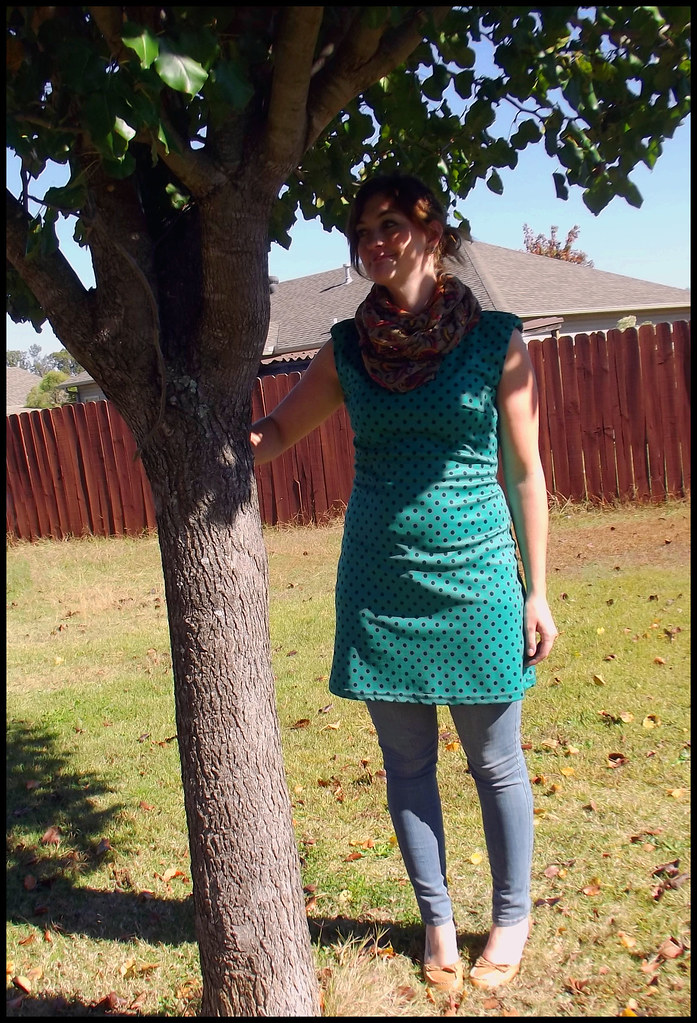
Somehow last time, by simply sitting at the first table with spare chairs, I ended up getting myself assigned to that table. Earlier in the week I was included in a group text from an unknown number saying it was our table's turn to bring food. I didn't even know I was a part of a table, but I love bringing food! Potlucks! So I offered to bring something (pumpkin of course) to contribute. I got up this morning early enough to get make-up on and put on a cute outfit (new skinny jeans, heels, a cute dress, infinity scarf), and I made apple pumpkin breakfast cookies*. I was really quite excited about all of this!

When I arrived, the nerves hit me like crazy. My hands were actually shaking as I put out the cookies on my pretty three-tiered cake stand. Why was I so nervous?

I am not entirely sure, but I think it was because I really, really wanted to like MOPS. And I was afraid I wouldn't.

It has so many of those qualities of church that I miss. The community especially. I really want to make new friends, socialize my son more, and have a thing I regularly go to. I am so desperate for a community  But I felt very vulnerable.

My thoughts were things like these:

Will they still like me when they find out I'm not a Christian?

Will they accept me when they find out I'm not one of them?

Will they view me with suspicion or keep me at arms length if I use the A-word?

Will they try to (re)convert me?

Am I going to end up considered a missionary project, rather than a friend?


I was already prepared for the praying and the Bible verses, and I was okay with all of that being a part of the group's purpose. I just worried about fitting in. Believe it or not, being anything other than some denomination of Christian makes it very hard to fit in here in the South.

So after I shakily put out my cookies, I filled my own plate with the Orange Table's delicious homebaked goodies and poured myself a cup of coffee and took my seat at "my" table. Victoria was already there, giving me someone to talk to and chill out a bit with. We small talked around the table before the announcements started, and then we had a speaker. The speaker was rather entertaining - he did a magic show which he then tied up with the topic of discussion "Taking Risks". Then it became table discussion time. The table leader went through four discussion questions like "When did you take a risk?" and "How will you teach your kids to take risks?" Girls at the table, timidly at first, spoke up to answer some questions, and eventually the conversation began to flow a little more. Nothing ground-breaking was said, but I got the feeling that a few people who needed to speak got the opportunity to do so, and I was touched by that. Afterwards, someone suggested arranging a table-wide play date with our kids. By the time we left, I felt I'd made a few acquaintances and had three new events to mark tentatively on my calendar - a play date, the Ladies' Night Out and the Christmas party. I even caught a couple of names.

I'm feeling optimistic about this group. I enjoyed it this morning, and I think I'll go ahead and join. I still feel nervous, afraid of how things could possibly change once it comes out that I'm atheist. But as my friend Esther said tonight at our kids' swimming lessons, if they don't accept me, they aren't acting like Christians. It was comforting hearing that come from a Christian, because while I know that this is true, and while I myself had tons of non-Christian friends when I was a Christian, I also can't help but notice how un-accepting some people can really be. It sucks being vulnerable; it's hard walking into a room full of people, knowing you are different, especially in such a culturally unwelcome way, and hoping to make friends.

I just want a community again. One with no strings attached. And singing, they need to add singing.


****

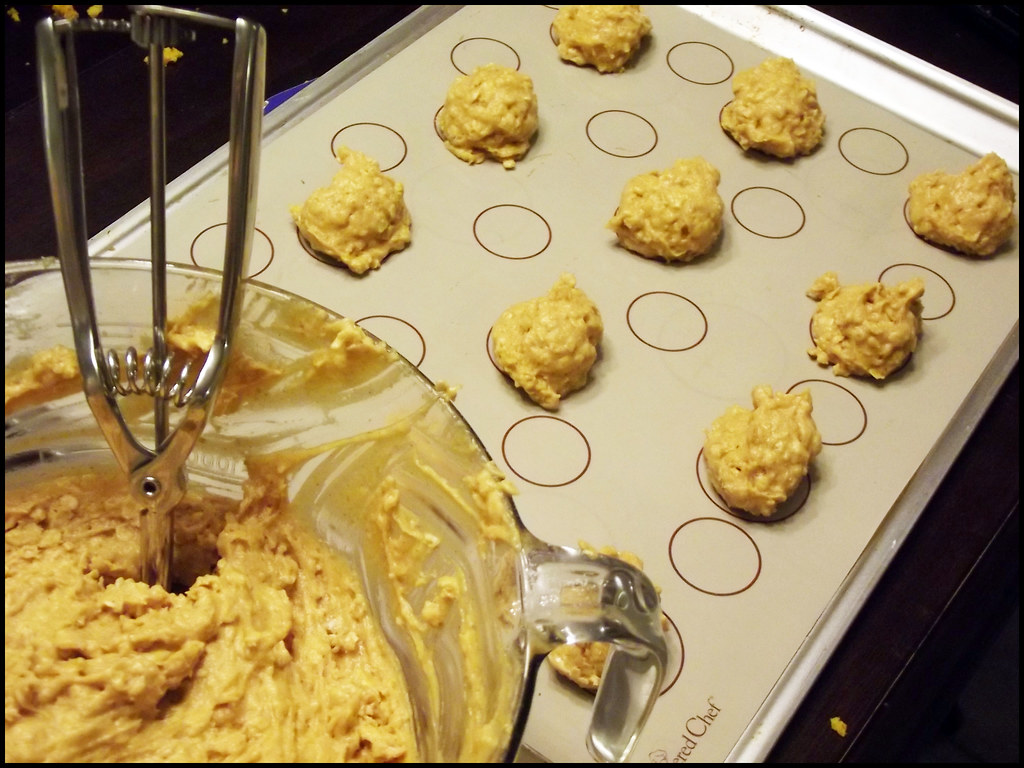
Apple Pumpkin Breakfast Cookies!!

I had picked out a recipe for Paleo Pumpkin Breakfast Cookies, but when I actually went to make them, I realized the recipe called for a few things I didn't have, like almond butter. So I searched and searched for a recipe that included ingredients I already had, and finally came across this one from Nestle (boo, hiss!). I didn't have every single ingredient, but I had enough substitutes to make it work. I ended up adapting the Nestle recipe somewhat and the end result was Apple Pumpkin Breakfast Cookies. They were very good, especially straight out of the oven! They are a little cakier than I wanted, and stickier because of the apple sauce, but still really yummy. The recipe makes over 5 dozen, so we actually have quite a few left. Someone needs to come over stat and eat them for us.

Ingredients (after adaptation)
2 cups all-purpose flour
1 1/3 cups quick oats
1 teaspoon baking soda
1 teaspoon ground cinnamon
1/2 teaspoon salt
1/2 cup butter, softened
1/2 cup applesauce
1 cup packed brown sugar
1 cup granulated sugar
1 cup pumpkin puree
1 egg
1 teaspoon vanilla extract
1 apple, cored and finely chopped (peeled if desired, but I liked the flecks of red color)

Mix dry ingredients - flour, oats, baking soda, cinnamon and salt in small bowl. In larger bowl, beat butter, applesauce, brown and white sugar on medium speed until well combined. Beat in pumpkin, egg and vanilla just until mixed. Mix in apple. Scoop onto a greased cookie sheet and bake each batch for about 14 minutes at 350°F. Cool on wire racks.

I used a medium scoop and got five dozen and four cookies out of this recipe. And like I said, straight from the oven, these are heavenly. At room temperature, they are a little sticky, so I'm going to refrigerate them tonight to see what texture they come out when cold. Pretty good recipe. Will I make them again? Maybe. Maybe if I get invited to another potluck.


Monday, October 06, 2014

Emergency Rooms: To Go, or Not To Go?

Today started like any other day. Except for the whole going-to-the-ER part.


I won't get into all the gruesome (or shall I say "poo-some"?) details, but let's just say I was more than mildly concerned over the ratio of poop to blood in my two year old's diaper this morning. I know. Gross.

My plan for today had been to drive to Conway, about 45 minutes away, to attend a Democrat campaign rally in which Former President of the United States Bill Clinton was going to be speaking, among other Arkansas politicians, including Mike Ross who is running for Governor. But all that was changed when after changing an alarming diaper, I called my doctor's office for advice, and their advice was Emergency Room.

I've been to my share of emergency rooms. Having three kids has made sure of that. And I'm well aware of the magic that happens when one steps into an emergency room; you can be bleeding out your ears before you walk through those doors, but before you even finish signing your name on the form, you will be right as rain again. And as you sit in that waiting room for what feels like a good quarter of your life, you will spend the entire time thinking, "I'm perfectly fine now. I don't need to be here. Why did I come here? I'm perfectly fine now!" It's no different with children. They can show symptoms of extreme fatigue, high fevers, listlessness, pain, and uncontrollable crying, but they will be totally healed once you walk through those doors, making you look like an overreacting, irrational parent.

At least that's almost always been my (admittedly very fortunate) experience. Today was no different.

Well, except for one teeny tiny "insignificant" difference.

This ER visit was going to cost me.

Under the National Health Service in the UK, ER visits (called the A&E - Accident & Emergency) are free. "Free" of course meaning paid for by taxes, but for all intents and purposes, the visit to you on each occasion is free. I have taken sick kids to A&E, I've taken second-degree burns to A&E, I took an almost completely amputated four-year-old's fingertip to A&E. Each experience came with its own worries, tears and anxieties - and sometimes regrets when upon arrival, that darn magic occurred and we were healed before ever seeing a doctor. One concern that never popped up, however, was how the hell are we going to pay for this?

By the time I arrived at the ER this morning, I was pretty sure my son was fine. I was a little embarrassed for even coming. I kept justifying my visit with the doctor's orders to go, my own Google MDing, and the ever important peace of mind that I would have by choosing safe over sorry. After all, possible (even if improbable) internal bleeding isn't one of those "wait and see" situations, right? But what was upsetting me to the point of tears was the bill that will surely arrive in the mail very shortly.

We are extremely fortunate to be insured. In America, most insurance plans are provided by employers. However, that does not mean that all working families are insured. Employers and legislation have set all kinds of rules for who must be offered an insurance plan, but if you are ineligible because you work under a certain number of hours, or if your wages are simply too meager to be able to afford those insurance plans, you are very likely uninsured. In Arkansas, we do have a government program for children called ARKids thankfully, but as I discovered when we first moved here and had no jobs for over a month, it's difficult to find a doctor's clinic that has not filled all of its ARKids slots. As for adults, there was nothing. Adults were in between that rock and hard place of choosing to either forgo care, or visit the ER - followed by insurmountable medical bills - and either paying those bills and increasing their financial burden or simply refusing to pay those bills, destroying their credit ratings even further, and for many honest, hard-working people, injuring their sense of dignity and pride. Not to mention increasing the cost to taxpayers. Until Scott got hired, we both walked on eggshells and drove extra slowly to prevent any injury to either of us, before we were covered by his company's insurance.

Last year, before we moved here, I came over to visit with just my son to attend my dad's military retirement ceremony. A few days before we were scheduled to fly back to the UK, ten month old Jaguar came down with a fever and began pulling at his red little ears. Ear infection. I didn't know what to do. I couldn't put a baby on a plane with an ear infection! Yet we were uninsured. I got a taste of what it is like for millions of Americans who do not have insurance. My dad generously gave me a blank check and told me to just pay whatever it cost. Not only did this make me feel terrible for putting this burden on him, but I was also reminded that not every family has someone to hand them a blank check in an emergency. It turned out, however, that the check was never needed because no free or drop-in clinic would see my son because he was under 18-24 months, depending on the clinic. I would have to take him to Children's Hospital, which would have cost even more.

I panicked over this. I couldn't ask my dad to pay all that. I ended up going the wait-and-see route. If he was still unwell the day before the flight, I'd go. And I'd pay for the antibiotics out of pocket too. Somehow.

Luckily, some of that ER magic must have been swirling around the drop-in clinics because a few days later, his fever lifted and the redness in his ears faded. He was acting happy again, and I took the chance and flew us back home without seeing a doctor.

But I'll never forget how scared I was as a mother with a sick baby and nowhere to turn for medical care.

It turned out today that Jaguar was perfectly fine, or so the doctor suspects. No tests were run so I am hopeful that I'll only have to pay the ER's copay when the bill comes in. It's still a chunk of change, but I'm grateful that we are fortunate enough to have insurance.

I'm also grateful that thanks to the Affordable Care Act - which is certainly not the best plan in the world, I readily admit - many other Americans now have insurance too. And I'm very grateful that Arkansas took the "private option", aka the Medicaid Expansion, which uses federal Medicaid dollars to buy private insurance for the working poor. This was already possible for some, but the expansion increased the eligibility to more families by lowering the income level. Before the expansion, people living at 138 percent of the poverty level were still too "rich" to qualify. Now a quarter-million Arkansans have insurance who previously did not.

For what it's worth, I am actually avidly against the insurance concept anyway. I am far more in favor of universal health care and believe it is a basic human right, not saved just for the wealthy or even the working, but every single human being, good, bad or somewhere in between. Private insurance is a great option for those who want it and can afford it, and yes, the US has some of the best health care in the world, but if a poor person cannot access it, what good does that do for them? Basic free health care - regardless of the dollars it costs taxpayers - should be an inalienable right sitting right up there next to "life, liberty and the pursuit of happiness". I, for one, am more than happy to pay a little more in taxes to know that my family and my neighbors and my fellow citizens will have access to health care when they or their parents or their children need it.

So, after leaving the ER, I realized I still had time to make it to the campaign rally. Now I was feeling even more motivated to go. The candidate for Governor, Mike Ross, is very much in favor of keeping the private option for Arkansas, while his opponent Asa Hutchinson, is not so keen on it, and has said he would like to "review" it and possibly repeal it. After my little ER visit, I wanted all the more to support the guy who will protect this expansion and keep people insured.

I drove to Conway and was relieved to find that parking on the university campus was easy and signs saying "Clinton Shuttle" were clearly posted. Jaguar and I somehow managed to get right up to the front left side gate, where we saw everything from up close. Jaguar enjoyed all the excitement in the air and cheered accordingly, often repeating the crowds' exclamations of "Yes!" and receiving lots of "Awws!" in response. We heard speeches from several Arkansas Congressmen, District representatives, the Mayor, State Representatives in Washington, the current Arkansas Governor Mike Beebe, Mike Ross and finally Bill Clinton. It was a lot of fun. I even got to shake Bill Clinton's hand at the end and Jaguar got a hair mussing and cuddle from the Former President of the United States. I tried to get a picture of this, but Jaguar knocked the camera out of my hands. Here's what my picture of Clinton and Jaguar ended up looking like.


I think that was his sleeve.

I got some other good photos though, or at least not terrible ones. Being off to the side meant I was super close but at a terrible angle for photography. Plus I had a Jaguar pulling at my camera.


Mark Pryor, Mike Ross, Bill Clinton


*****

As for the October Dress Project, I was too exhausted with my overly eventful day to take good photos, so here's what I've got.

The Dress over fuschia skinny cords, black slip ons and a zebra belt.  No make-up, thanks to leaving the house this morning in a tizzy. I brushed my teeth at least.

Lolly seems to have dropped out of the ODP, which I sort of expected. She loves her dresses too much. Fifi, however, is still in the game. Yesterday she wore just a plain white t-shirt over Her Dress. Today she dressed it up with a pink owl long-sleeved button-up top and brown cowboy boots. Isn't she adorable?